

How the O.J. Simpson Trial Inspired My Career in Forensic Science
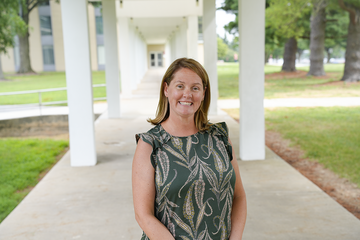
NIST researcher Erica Romsos’ research is helping to make Rapid DNA technology more effective.
Credit: Megan King/NIST
If you’ve ever watched a crime show or movie, you probably know that DNA can be a vital part of public safety and police work. In those fictional worlds, a detective might swab a sample and have the culprit's identity almost immediately.
However, collecting and processing DNA is much more complex than it appears on CSI.
In the real world, DNA samples are typically processed in a laboratory under very strict protocols. There are multiple review steps to ensure accuracy. That process can take from eight hours to a few days, depending on the sample.
Sometimes, law enforcement needs results much faster. This is where Rapid DNA technology comes in, providing results in as little as 90 minutes.
But speed cannot come at the expense of quality. I focus on making sure these quick results meet strict accuracy standards, so law enforcement officers know they’re getting the correct information quickly.
How Rapid DNA Works
Rapid DNA is often used to identify people who have been arrested or victims in mass casualty events, such as plane crashes, wildfires and building collapses. In some cases, it can be used in traditional DNA casework, such as murder investigations.
The Rapid DNA equipment is about the size of a standard office printer, more compact than laboratory equipment. The user (typically law enforcement) collects a sample with a cotton swab and places it into a specialized cartridge inside the machine. The machine extracts the DNA, creates many labeled copies, and then separates those copies to create a person’s profile, or genetic fingerprint.
The Rapid DNA systems use two types of cartridges to create a profile. One is for high-quality, high-volume DNA, such as what you would find in a cheek swab. A cheek swab is a controlled collection process that yields higher-quality DNA samples.
A different type of cartridge is used for forensic evidence, such as blood found at a crime scene. These types of samples are much more challenging. In these cases, the quality and amount of DNA are much lower.
Testing Rapid DNA
If the DNA samples meet the FBI’s strict quality requirements after analysis, law enforcement works with a lab to upload them to the National DNA Index System (NDIS). This database helps solve crimes and identify missing and unidentified people. But how can users know that the equipment they use to analyze DNA samples actually meets the FBI’s strict standards?
That’s where NIST comes in. Our work provides the criminal justice community with confidence that the equipment they rely on is accurate.
We also help law enforcement and lab professionals determine the tools’ limitations, including which types of evidence are suitable for Rapid DNA testing. DNA from multiple people, for example, should go to a traditional crime lab, not a Rapid DNA instrument.
Credit: digicomphoto/Shutterstock
NIST is uniquely suited for this role. This is not just because of our scientific expertise, but because we are a neutral, unbiased source focusing on the measurement itself.
One of my primary roles is to facilitate interlaboratory studies. In these studies, multiple laboratories test the same material using identical methods to ensure consistent, accurate results.
We’ve recently finalized an interlaboratory study examining both pristine DNA samples (easier to test) and mixed DNA samples from multiple people (harder to test) using new Rapid DNA cartridges. We prepared samples, collected and analyzed data, and made our results available to the public. Our study helped inform the FBI standards that crime laboratories must follow for Rapid DNA.
How the Trial of the Century Influenced My Forensics Career
People often ask why I chose forensic science. I have always been interested in the legal system and true crime. My first exposure to forensic science was the O.J. Simpson trial in 1995.
This was the first major trial in which science, rather than a traditional outline of evidence, was the focus of the criminal proceedings. This trial also called into question many lab and law enforcement processes used at the time. One of the biggest issues was the evidence collection and its impact on DNA analysis.
My mom had wanted to pursue a legal career, but she put that aside to raise my sister and me. She watched every minute of the trial. It was always on in the background, and we discussed it, including the DNA evidence, extensively at the dinner table each night.
Years later, I earned my undergraduate degree in biology from Valparaiso University, in Indiana. I remained interested in molecular biology and forensic science. At the time, there were very few schools offering master’s degrees in forensic science, and I was accepted into the forensic science program at the George Washington University, in D.C.
I joined NIST in 2009, and my research has focused on Rapid DNA testing and standards development.
One of the aspects I enjoy most about my job is helping test new Rapid DNA-related equipment and technologies.
Often, when companies develop something new for forensic DNA testing, NIST is asked to test it. We let companies know early on what issues we’re finding, so they can improve the product.
Our goal is for the scientific methods used in the criminal justice community to be accurate, precise and thoroughly tested. When labs purchase and start using equipment, we want them to be confident they are getting the very best results possible.
Looking Toward the Future of Rapid DNA Analysis
One challenge of studying Rapid DNA is that the process consumes the entire sample. So, an officer or technician puts the sample into the cartridge, gets one shot at the test, and doesn’t get that sample back for any further analysis.
The problem is — lots of things can go wrong. The machine could fail. The power could go out at the exact moment they’re testing that sample, and then the sample is gone forever.
Additionally, some states have laws requiring samples to be saved in case a defense attorney requests retesting.
I’m currently studying how we can potentially preserve those samples used in the Rapid DNA process. I’m doing this by exploring how we could create duplicate samples from a single original sample while retaining the same DNA profile and quality. We call this subsampling.
Subsampling to preserve the original sample would help law enforcement use Rapid DNA while still complying with state laws on sample preservation. It would also enable law enforcement to use Rapid DNA for investigative leads while sending the original sample to the laboratory.
I continue to work to bridge the gap between the speed of the field and the rigors of the lab. That’s because it’s vital that forensic science remains reliable and accurate and that any limitations in the systems are identified and addressed.
Legal Disclaimer:
EIN Presswire provides this news content "as is" without warranty of any kind. We do not accept any responsibility or liability for the accuracy, content, images, videos, licenses, completeness, legality, or reliability of the information contained in this article. If you have any complaints or copyright issues related to this article, kindly contact the author above.
